

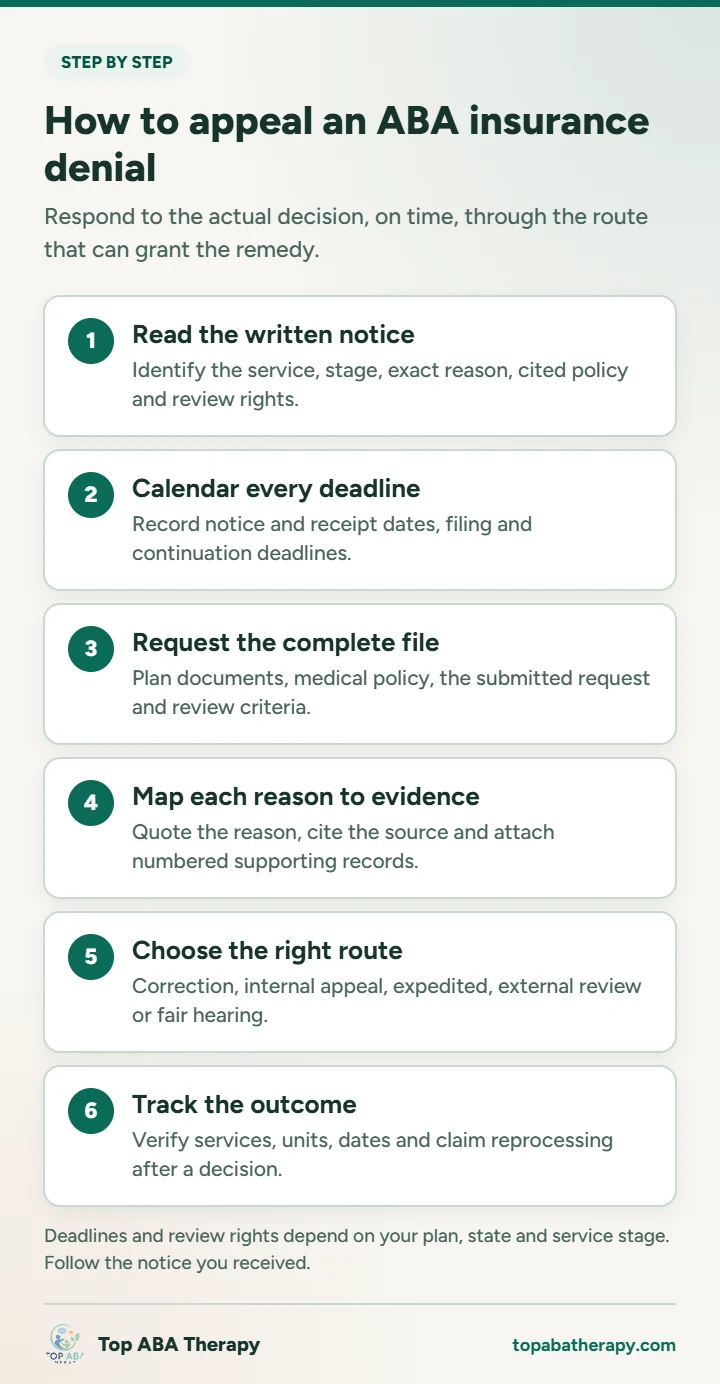
Quick answer: To appeal an ABA denial, start with the written decision. Identify the exact service, reason, plan provision, evidence, deadline and review rights, including any urgent route. Request the relevant file and build the response around the actual denial. Deadlines and continuation-of-care rules depend on the governing plan and circumstances.
How do you identify what was actually denied?
Start with the service stage and reason
A denial can occur before service, during continuing authorization, or after a claim. The first response depends on the stage and stated reason. If the denial came during an initial request or renewal, our guide to ABA prior authorization and renewals explains the documents usually involved.
| Denial category | Evidence to verify first |
|---|---|
| Eligibility, plan, or network | Enrollment dates, plan product, legal provider, location, identifiers, and dated network evidence |
| Missing authorization or administration | Authorization scope, submission receipt, missing-form request, referral, signatures, and portal or fax history |
| Coding or claim processing | Claim, explanation of benefits, remittance, service record, identifiers, units, place, modifiers, and filing dates |
| Medical necessity, intensity, or duration | Current policy, individualized assessment, goals, baseline, outcomes, burden, alternatives, and transition rationale |
| Benefit exclusion or experimental classification | Governing plan language, amendments, cited definition, medical policy, and evidence named in the notice |
Do not appeal an assumed reason or translate an unfamiliar code from an unofficial page. Request a complete, understandable notice if the explanation is missing. When network, coverage, or cost facts are still unclear, use the insurance verification checklist before deciding what is disputed.
Extract the control facts
Record the member, plan, case number, provider, location, service, units, dates, requested scope, determination, effective date, exact reason, cited policy, evidence used, missing information, review rights, urgent criteria, filing route, deadline, receipt rule, and continuation provision.
If the notice conflicts with a portal or telephone statement, preserve both and request written clarification. Do not miss the stated deadline while waiting for a better explanation.
Calendar deadlines from the governing notice
There is no safe universal countdown. Timing changes with plan, jurisdiction, service stage, urgency, review level, and continuation request. Record the notice and receipt dates, filing deadline, time zone, delivery standard, and any earlier continuation deadline. Set an earlier internal date.
Request the plan and complete review file
Ask for the Summary of Benefits and Coverage; applicable Summary Plan Description and amendments; member contract; current medical policy; submitted request or claim; transmission history; relevant notes, reviewer credentials, criteria, and communications when accessible; and current appeal, external-review, fair-hearing, accessibility, and continuation procedures.

How do you build an evidence-based internal appeal?
Choose correction, appeal, grievance, or a combination
A wrong identifier, missing page, duplicate claim, or unmatched authorization may have a correction route. Get the case number, owner, expected action, and result. Use a formal appeal for disputed benefits, medical necessity, intensity, evidence, plan interpretation, network access, or an unresolved correction when applicable.
A grievance may address delay, directory accuracy, communication, access, or service quality while an appeal challenges a benefit decision. Terminology varies. Ask which route can grant the remedy you need, and do not assume filing one preserves the other.
Map each reason to evidence and a remedy
For every denial statement, record the exact quoted or faithfully paraphrased language, governing source and effective version, factual disagreement, supporting evidence, attachment number, and requested remedy. A concise mapped response is stronger than pages of narrative that never address the criterion.
Mark uncertainty. Never alter a record, backdate a signature, exaggerate risk, or copy another person’s appeal. Use only relevant health information and transmit it securely.
Structure the formal submission
Identify the member and case, label the formal appeal, name the determination, and request a specific action. State the notice and filing dates, identify the governing plan and policy version, answer each reason in order, and provide a numbered attachment index.
Document network-access failures
Confirm the legal entity, site, relevant identifier, rendering professional, plan product, dates, and service. If no qualified in-network option is available, record calls, dated directory entries, distances, waitlists, schedules, languages, accessibility, competence, and why each option failed.
Ask the plan about care coordination, network-gap exceptions, single-case agreements, continuity, and access complaints. A public directory record can support a dated search history; it cannot establish current participation or entitlement to an exception.
Which urgent, external, ERISA, or Medicaid routes may apply?
Expedited review
Some plans allow expedited review when delay could seriously jeopardize life, health, ability to regain function, or another defined urgent condition. Ask for the exact standard, who must certify it, and the required channel. A treating professional should provide accurate clinical support. Immediate danger or a medical emergency calls for emergency care, not a wait for insurance review.
External review
HealthCare.gov describes external review for certain denials in applicable plans, often after internal appeal. Eligibility, subject matter, exhaustion rules, deadline, state or federal administration, and binding effect vary. Read the final internal decision and current instructions. Not every coding, administrative, network, or exclusion dispute follows the same path.
Job-based and ERISA considerations
Employer coverage may be fully insured or self-funded. A third-party administrator can process claims while a plan administrator retains other duties, and state insurance remedies may apply differently. Request funding status, Summary Plan Description, amendments, plan administrator, and claims procedure. EBSA offers Benefits Advisor assistance for applicable plans.
Medicaid appeals and fair hearings
State Medicaid and managed-care processes differ. A plan appeal, state fair hearing, expedited review, continuation request, ombudsman, or other channel may apply. Follow the notice precisely. For background on how this coverage is structured, see how Medicaid covers ABA by state.
Continuing existing services during review
Some systems allow previously authorized services to continue when a review request is filed by a specific, sometimes short, deadline and other conditions are met. Liability may differ if the appeal fails. Ask what amount continues, who must request it, which route and date preserve it, whether repayment risk exists, how billing works, and what happens at expiration. Never borrow a continuation rule from another plan or state.

How do you track the decision and avoid appeal errors?
After a decision, compare it with the requested remedy. For an approval, verify the provider, services, units, dates, setting, conditions, claim reprocessing, member cost, and start or restart process. A favorable appeal does not create staffing or guarantee correct later claims.
If the denial is upheld
Read the final decision for the next available level, its deadline and the filing method. Depending on the plan and jurisdiction, that may be a second internal level, external review, a state fair hearing or a complaint to the relevant regulator. Ask the provider how a gap in authorization affects the schedule, and plan for the interim, including funding options outside insurance if coverage stays disputed.
Keep a single appeal log
For every contact, record the date, time, person or department, reference number, what was said, documents sent, proof of delivery and the next action with its due date. A log turns scattered calls into evidence and makes it easier to escalate a missed deadline.
Common appeal errors to avoid
- Answering a reason the plan did not actually give
- Missing a filing or continuation deadline while waiting for a callback
- Relying on a phone statement without a reference number or written confirmation
- Citing an outdated policy version instead of the one in effect on the service dates
- Sending records without the case number, a cover letter or an attachment index
- Keeping no proof of submission, such as a portal receipt or fax confirmation
Frequently asked questions about ABA denials and appeals
Should I call the insurer before filing an appeal?
A call may clarify or correct an error, but it may not preserve a formal deadline. Read the notice, document the call, and follow the required appeal method unless authoritative written guidance says otherwise.
What records should I request after an ABA denial?
Request the governing plan and policy, adverse notice, submitted request or claim, relevant review file and criteria where available, communications, and current review instructions. Rights differ, so follow plan-specific procedures.
Can a provider write the appeal for the family?
Providers often supply clinical records or rationale and may assist administratively, subject to authorization and policy. The member remains responsible for understanding deadlines, requested remedy, submitted information, and representation arrangements.
Does medical necessity guarantee that an appeal will win?
No. The reviewer applies plan terms, evidence, procedures, and applicable law to the request. Accurate individualized clinical evidence can strengthen a response but cannot guarantee reversal.
How long does an ABA insurance appeal take?
Timelines depend on the plan, review level, urgency and jurisdiction, so check the notice and plan procedures for the decision timeframe. When you file, ask for the expected decision date, record it, and follow up in writing if it passes. Ask whether an expedited route applies when delay could seriously harm health or function.
The bottom line
Handling an ABA insurance denial and appeal comes down to precision. Identify exactly what was denied and why, calendar every deadline from the governing notice, request the full file, and answer each stated reason with numbered evidence through the route that can actually grant the remedy. Keep one log of calls, submissions and receipts, and verify authorizations and claims after any decision. While coverage is being sorted out, compare ABA therapy providers near you so you know your in-network and backup options.
Sources
- How to appeal an insurance company decision | HealthCare.gov
- Early and Periodic Screening, Diagnostic, and Treatment (EPSDT) Guide for States: Coverage in the Medicaid Benefit for Children
- U.S. Department of Labor, Employee Benefits Security Administration – Understanding Your Mental Health and Substance Use Disorder Benefits