

Quick answer: Some Aetna-administered plans cover qualifying autism-related ABA, but Aetna is not one benefit. Commercial and Medicaid products can follow different rules. Verify the exact plan, provider, service, network, documentation, authorization and family cost, and request a member-specific written answer rather than relying on a general coverage page.
Coverage note: This is general educational information, not a benefit determination or individual medical, billing, appeal, insurance, or legal advice. Policies change. Use the member card and current plan documents, and retain the plan’s written response.
What determines whether an Aetna plan covers ABA?
| Aetna coverage check | What to confirm for your exact plan |
|---|---|
| Plan identity | Product, funding arrangement, member benefits and applicable jurisdiction. |
| Provider | The specific clinician and service location, not only the company name. |
| Authorization | Covered service, documentation, approved units and renewal dates. |
| Member cost | Allowed amount where available, deductible, copayment or coinsurance and exclusions. |
The product and funding arrangement come first
Aetna is a brand, insurer, and administrator across many products. An employer policy, individual plan, self-funded employer plan, Medicare-related product, and each state Aetna Better Health Medicaid program may use different benefit language and processes. Even two cards with an Aetna logo may point to different networks or behavioral-health administrators.
Clinical policy and member benefits do different jobs
Aetna publishes Clinical Policy Bulletins concerning autism-related services and ABA. Aetna also explains that these bulletins help administer benefits and do not replace the member’s contract. A bulletin can describe a clinical-review framework; it cannot promise that the member has the benefit or that Aetna will approve a specific request.
Keep five questions separate: Is the person eligible? Is the requested service a benefit? Does the request meet applicable clinical criteria? Are the provider and location recognized and in the required network? Was authorization obtained for the correct dates, units, and services? A favorable answer to one question cannot silently answer the others.
Aetna Better Health rules are state and product specific. Public New Jersey materials, a Kentucky notice, and a Louisiana form show that state programs may publish distinct access routes, records, forms, and authorization instructions. Those examples are useful for understanding what a plan might ask. They cannot be transferred to a commercial plan or another state’s Medicaid program. For the Medicaid side, see how to verify Medicaid ABA coverage by state.
Network listings need a second check
An organization may contract for one product but not another. Participation can also differ by service location, supervising clinician, rendering professional, age group, or service. Search tools and provider statements can become stale. Verify the organization, physical or telehealth location, supervisor, and relevant rendering staff against the exact network.
Ask both the plan and provider to state the full product and network they checked. Record the date, representative, contact route, and reference number. If the answers conflict, do not average them. Request written clarification before care starts or before relying on an estimate.

How can a family verify the exact Aetna ABA benefit?
Call the number on the member card
Use the member-services number printed on the current card. A general Aetna number may route to the wrong product. Confirm active eligibility and ask whether a separate behavioral-health administrator handles autism services or ABA.
Do not ask only, “Do you cover ABA?” A yes can conceal an exclusion, network mismatch, age rule, documentation gap, or unapproved service. A no can reflect an agent searching the wrong benefit category. Ask the representative to identify the plan provision or current policy supporting the answer.
Request the criteria and submission route
Depending on the product and request, review materials may address diagnosis, assessment, baseline information, person-valued goals, requested services and hours, setting, caregiver involvement where clinically appropriate, coordination, progress, reassessment, transition, provider qualifications, and discharge criteria. These are examples of possible review criteria; the exact product determines what is required.
Audit the written authorization
If Aetna or the plan administrator approves the request, compare the letter with the treatment plan. Check member and provider identifiers, service or code, location, units, frequency, start and end dates, and reassessment conditions. An approval for one organization, clinician, or site may not follow the member after a change. Our guide to ABA prior authorization and renewals covers what to track between approvals.
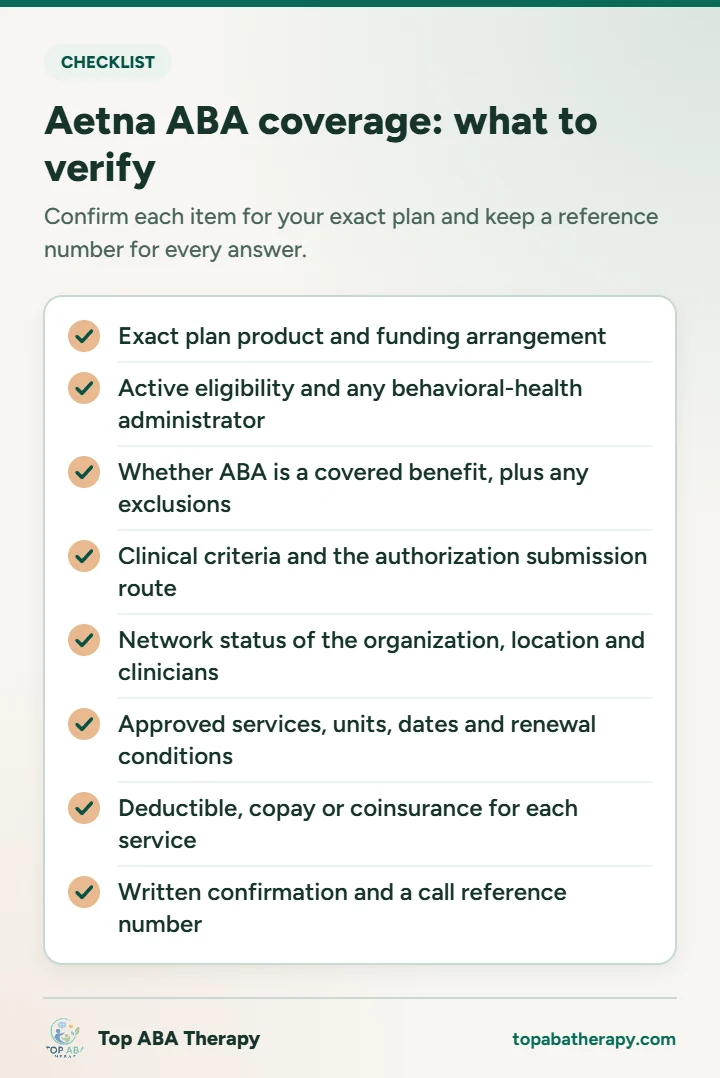
Questions to ask on the call
- Is ABA a covered benefit under this exact plan, and are there exclusions or age limits?
- Does a separate behavioral-health administrator manage autism or ABA services?
- Is prior authorization required for the assessment and for ongoing treatment?
- Are this organization, location and supervising clinician in network for this product?
- What deductible, copayment or coinsurance applies to each service, and how much has been met?
- Which plan provision or policy supports your answer, and what is the reference number?
For a fuller script, use our ABA insurance verification call guide.
How should families estimate cost and respond to a denial?
Build the estimate from plan variables
If a service is covered, the member may owe a deductible, copayment, coinsurance, or another plan-defined amount. Ask for current individual and family accumulators, the in-network rules for each requested service, and any separate behavioral-health or out-of-network structure. Confirm whether cost sharing applies per visit, service, day, or another unit.
Ask the provider for a good-faith estimate based on the expected service mix. Do not calculate coinsurance from the provider’s billed charge unless the plan confirms that figure is the applicable basis. The allowed amount and final claim processing may differ. Model assessment, direct service, caregiver guidance, protocol changes, and reassessment separately, then label the result as an estimate.
Out-of-network care can introduce a second deductible, higher coinsurance, reimbursement limits, balance billing, or no benefit. If the network cannot provide timely access, ask the plan whether a network-gap or single-case process exists and what approval must be in place before service.
Read the denial reason before building an appeal
A notice may concern eligibility, an excluded benefit, diagnosis, medical necessity, missing records, network status, authorization, setting, provider qualifications, coding, units, or dates. Identify the exact reason, plan language, policy, deadline, destination, and review level. A benefit exclusion and a medical-necessity denial call for different evidence. Then work through our ABA denial and appeal steps.
Top ABA Therapy verifies selected public provider facts from permitted evidence, but payer participation remains a dated lead unless the plan confirms it. Inclusion does not mean that we endorse clinical quality or guarantee coverage, availability, price, authorization, or payment.

Frequently asked questions about Aetna and ABA
Does every Aetna plan cover ABA therapy?
No. Benefits, exclusions, clinical criteria, networks, authorization, provider rules, and cost sharing depend on the member’s exact product and request.
Is an Aetna Clinical Policy Bulletin proof of coverage?
No. A bulletin may explain a clinical-review framework. Aetna states that member plan documents control actual benefits and exclusions.
Does an in-network provider listing guarantee payment?
No. Verify the product, organization, location, supervisor, rendering staff, service, eligibility, authorization, and claim requirements. Payment also depends on accurate claim processing.
Can one state’s Aetna Better Health rules apply in another state?
Do not assume that. State Medicaid products publish their own handbooks, criteria, forms, networks, and appeal routes. Use the member’s current state program materials.
Does Aetna require prior authorization for ABA therapy?
Requirements vary by Aetna product and service. Ask member services whether authorization is needed for the assessment and for ongoing treatment, who submits the request and which records are required. Keep the approval letter and check its dates, units and provider details against the treatment plan before sessions start.
The bottom line
Does Aetna cover ABA therapy? Some Aetna-administered plans do, but the answer depends on your exact product, funding arrangement, network, clinical criteria and authorization. Call the number on the member card, ask specific questions, record reference numbers, and get the benefit, network status and cost in writing before services start. If a denial arrives, respond to the stated reason. When your benefits are clear, find ABA therapy providers near you and confirm each one’s network status for your plan.