Quick answer: In-home ABA delivers assessment, teaching and caregiver collaboration in the person’s household. It can connect goals to routines such as dressing, communication, meals and transitions. Compare clinical fit, privacy, family workload, supervision and coverage before choosing the home setting; convenient delivery does not establish that it is the best option.
How does in-home ABA connect goals to daily routines?
| Home-session question | What to agree before starting |
|---|---|
| Where will sessions happen? | A usable space, privacy, household boundaries and access to ordinary routines. |
| Who participates? | Who delivers care, who supervises and which caregiver participation is actually expected. |
| What changes if the session is difficult? | Accessible breaks, refusal signals, safety arrangements and an escalation contact. |
| How will progress transfer? | Practice across relevant people and routines, with criteria for reducing support. |
Home-based care should begin with an individualized assessment, not a predetermined lesson plan. The supervising clinician identifies strengths, needs, preferences, relevant environments, and socially meaningful goals with the person and family. The treatment plan then defines what the team will teach, how it will measure progress, who will deliver each service, and how often the clinician will review the plan. Knowing how BCBA and RBT roles divide the work makes it easier to ask who will actually be in your home.
Sessions can be embedded in ordinary routines
Depending on the assessed goals, teaching may occur during getting ready, meals, play, homework, chores, community preparation, or transitions. The home is useful when the environment itself is relevant to the skill. It also allows the clinician to observe variables that may be difficult to reproduce in a clinic.
Caregiver involvement should be purposeful
Caregiver collaboration may include selecting priorities, learning how to support communication, arranging the environment, practicing a strategy, reviewing data, and planning what to do between sessions. It should not turn a parent or sibling into unpaid clinical staff or assume every household has the same time, language, ability, or resources.
What goals may fit home-based ABA?
Goals should follow assessment and informed decision-making, not the convenience of the setting. Examples may include:
- functional communication during recurring home routines;
- dressing, hygiene, eating-related routines, or household participation;
- play and leisure selected with the person and family;
- transitions between activities or locations;
- skills related to health and safety;
- caregiver implementation of agreed supports;
- generalizing a skill first learned elsewhere.

What benefits, boundaries, and safety issues should families weigh?
Natural context can make a routine directly observable and reduce family travel, but it does not guarantee that a skill will transfer outside the home. Easier caregiver access may support collaboration, yet the expected participation still needs to be realistic and voluntary. A familiar space may feel comfortable for one person and distracting or invasive for another.
Everyday materials can support functional teaching, while a clinic may offer equipment, controlled practice, or peer opportunities that a household cannot. Provider travel zones, cancellations, staff substitutions, sibling schedules, pets, and available space can determine whether the arrangement is sustainable. Treat each factor as a question to investigate, not a built-in advantage of home delivery.
Privacy, consent, and boundaries inside the home
Inviting a service team into a private home changes the practical relationship. The household is not a clinic. Before treatment starts, clarify where sessions may occur, whether bedrooms or bathrooms are ever relevant, who may be present, how staff handle recordings, where they complete notes, and what they may photograph or access.
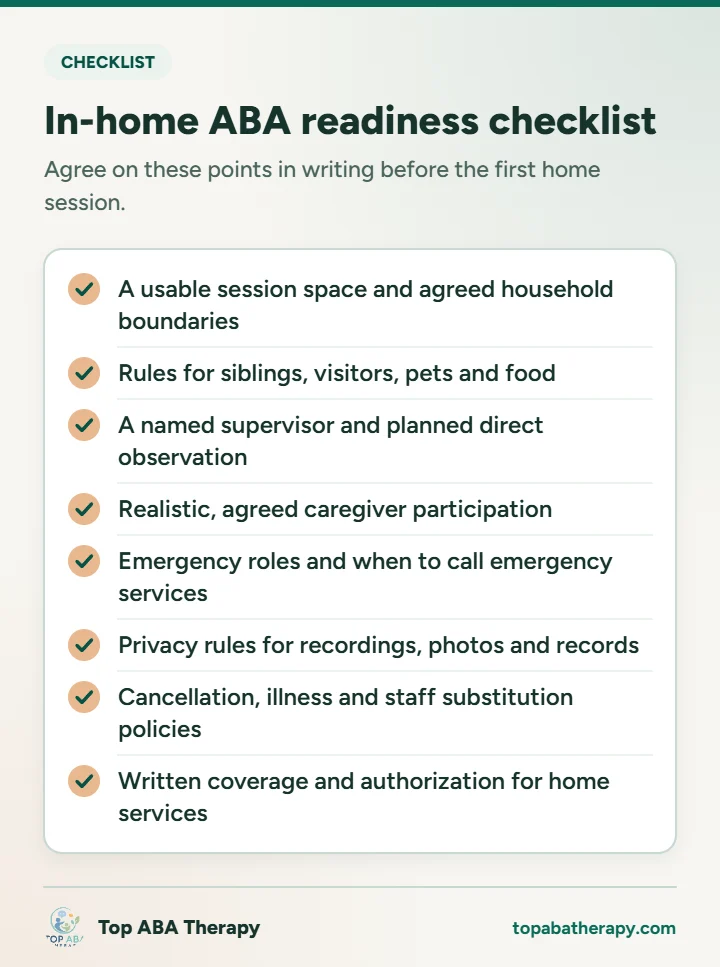
Safety and readiness checklist
Home conditions do not need to look like a clinic, but both the family and provider need a workable safety plan.
- Identify relevant medical, mobility, communication, elopement, aggression, self-injury, allergy, pet, firearm, pool, and environmental risks without assuming they apply.
- Define who is responsible during emergencies and when emergency services should be contacted.
- Confirm staff background-check, training, incident-reporting, and supervision practices.
- Establish rules for siblings, visitors, pets, food, transportation, and community outings.
- Decide how cancellations, severe weather, illness, staff substitutions, and missed supervision are handled.
- Protect electronic and paper records from household members, visitors, and unauthorized staff.
Safety planning must not become a blanket justification for restrictive procedures. Ask which less intrusive approaches the team considered, what oversight applies, and who will monitor and fade any restriction.
Household consent has limits: signing service paperwork does not grant unrestricted access to rooms, recordings, family members, or private routines. Define boundaries before the first session and revisit them whenever staff, goals, or technology change.
How do you evaluate an in-home ABA provider?
Ask the organization to explain its clinical and operational model in concrete terms.
Clinical fit
- Who performs the assessment and selects goals with the person and family?
- Why is the home the recommended setting for these goals?
- How are communication preferences, assent, culture, and quality of life incorporated?
- How are progress, unwanted effects, generalization, and maintenance measured?
- What triggers a plan change, setting change, referral, step-down, or discharge?
Staffing and supervision
- Which professional is accountable for treatment?
- Who will attend sessions, and how often will the supervisor directly observe?
- How are technicians trained for this individual plan?
- What happens when the assigned staff member leaves or calls out?
- Can the family see current credentials, licenses, exclusions checks, and disciplinary history where available?
Logistics and payment
- Which hours, travel areas, minimum sessions, and cancellation rules apply?
- Is caregiver participation required by the provider or payer?
- Does the plan cover home-based assessment, treatment, caregiver training, telehealth, and community practice separately?
- What written estimate and authorization will the family receive?
Use the broader provider selection checklist to compare ethics, competence, staffing stability, data practices, safety, and transition planning across organizations.
When another setting or a hybrid model may fit better
A center may offer controlled teaching space, equipment, observation rooms, predictable staffing, or planned interaction with peers. School, community, telehealth, medical, speech-language, occupational, and other services may also address needs outside an ABA provider’s competence or scope. For a side-by-side view, see how in-home and center-based ABA compare.
How to start without overcommitting
Begin with a consultation and credential check, then request the assessment process, proposed setting rationale, sample schedule, supervision model, privacy terms, safety procedures, cost or coverage verification, and transition criteria in writing. Observe how the provider responds to disagreement and whether it offers genuine choices. Before the first visit, confirm your plan covers home-based ABA for the exact services proposed.

Frequently asked questions about in-home ABA
Does in-home ABA mean every session happens inside the house?
Not necessarily. A plan may include household routines, nearby community practice, caregiver guidance, telehealth, or coordination with other settings when those components match the goals and authorization. Ask which locations are proposed and why each one is clinically relevant.
Must a caregiver remain in the room throughout treatment?
Provider, payer, age, safety, and supervision rules can differ. Clarify who must be present, what active participation is expected, and what happens when that arrangement is not feasible. Caregiver collaboration should be purposeful, accessible, and agreed upon.
Can siblings participate in home-based ABA sessions?
Only when participation serves an individualized goal and everyone involved has appropriate consent, privacy, and safety protections. Siblings should not be treated as unpaid assistants or lose ordinary access to their home because services are taking place.
Is in-home ABA better for generalization?
Practicing a skill where it is used can help, but transfer is never automatic. The plan should measure whether the skill appears with different people, materials, and settings and should add practice elsewhere only when that burden is justified.
Does insurance cover in-home ABA therapy?
Many plans that cover ABA can authorize home-based services, but setting rules, caregiver-presence requirements, and network status vary. Ask the plan whether home-based assessment, treatment, and caregiver training are covered for the exact provider, and make sure the written authorization names the approved setting.
The bottom line
So, what is in-home ABA therapy? It is individualized ABA delivered where daily routines actually happen, which can make goals concrete and reduce travel, but it also brings staff into your private space and asks something of your household. Choose it when the goals truly belong at home, set boundaries and safety plans in writing, and confirm supervision and coverage before the first session. When you are ready, find in-home ABA providers near you.