Quick answer: Center-based ABA delivers behavioral services mainly in a clinic. A center may offer teaching spaces, materials, nearby supervisors and planned peer activities. Ask how the team individualizes goals, respects refusal, checks safety and helps skills transfer beyond the clinic. Also verify staffing, travel, authorization and written costs.
How does center-based ABA work?
Care should begin with an individualized assessment conducted or overseen by a qualified professional. The clinician collaborates with the person and family to identify strengths, preferences, needs, environments, and socially meaningful outcomes. A written plan should define goals, procedures, measurement, responsible staff, supervision, review points, and criteria for changing or ending services.
What a center day can look like
Schedules vary by program and by person, but a center session often moves through a predictable sequence:
- arrival and a transition routine the person can anticipate;
- a mix of structured practice and play-based or naturalistic teaching;
- breaks, snacks, and personal care handled with dignity and privacy;
- small-group or peer activities when they serve an individualized goal;
- ongoing data collection by the technician, with supervisor observation at planned times;
- a handoff at pickup that tells caregivers what happened and what to practice.
Ask for a sample schedule for someone with similar goals, and ask how it changes when the person is tired, unwell, or distressed. To see where the center fits in the wider process, read about how ABA moves from assessment to review.

What can an ABA center offer, and what are the tradeoffs?
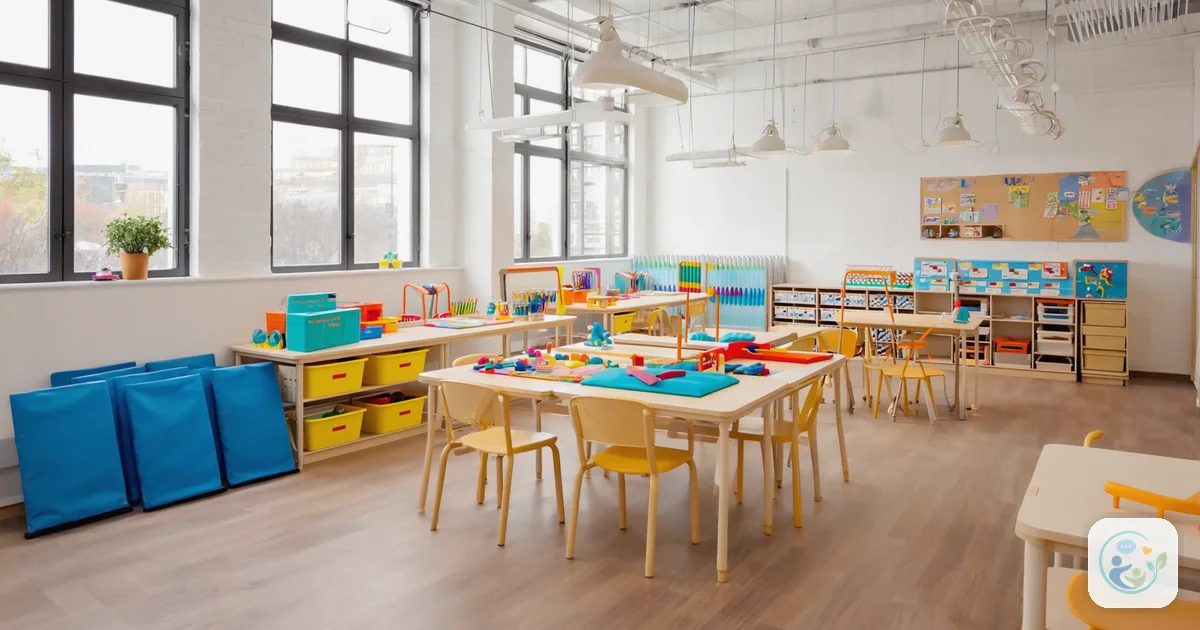
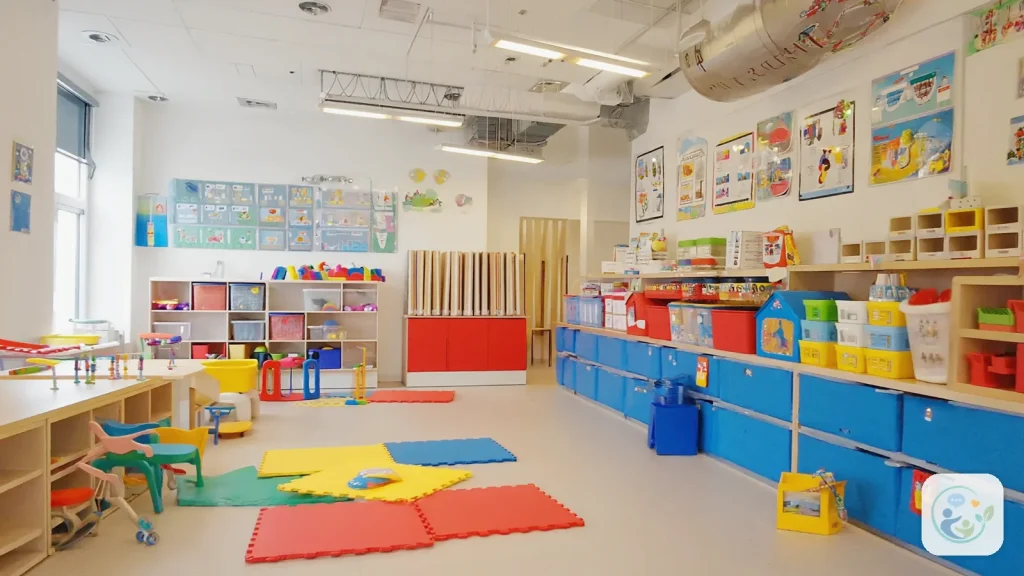
Facilities differ substantially. Some are small offices; others resemble classrooms, homes, play spaces, or multidisciplinary clinics. Possible features include:
- predictable rooms arranged for specific activities;
- materials that can be systematically selected or changed;
- space for daily-living, communication, leisure, or safety practice;
- direct observation by supervisors;
- nearby colleagues for consultation and staff support;
- planned opportunities with peers when clinically appropriate and consented to;
- controlled practice before a skill is used in less predictable environments.
| Center capability | Evidence to request |
|---|---|
| Arranged spaces and materials | Which individualized goal uses each feature, and how will performance transfer? |
| Nearby supervisors and backup staff | How much direct observation occurs, and how are substitutions disclosed? |
| Planned peer or group activities | Are participation, grouping, communication, privacy, and leaving voluntary? |
| Specialized equipment or routines | Is each feature needed, safe, and tied to an assessed outcome? |
| Separation from the household | How are shared spaces, observation, recordings, and records protected? |
| One consistent location | Can the person and family sustain travel, attendance rules, and fatigue? |
Peer opportunities require careful design
Being in the same building as other clients does not automatically produce meaningful social learning. Ask whether shared activities have an individualized purpose, how participants are grouped, how consent and privacy are handled, what happens when someone wants to leave, and whether interaction respects different communication styles.
How do staffing, safety, and generalization affect quality?
A center may employ behavior analysts, assistant-level professionals, technicians, administrative staff, and professionals from other disciplines. Titles and scopes vary. Confirm who is accountable for clinical decisions, who provides direct services, and which credentials or licenses apply in that jurisdiction.
Ask for the real supervision model
- How often does the supervisor directly observe this person’s services?
- Is supervision in the room, remote, recorded, or based only on notes?
- Who covers when the usual technician or supervisor is absent?
- How are staff trained and checked for competence on the individual plan?
- How many cases and staff does each supervisor oversee?
- How are concerns escalated without retaliation?
A credential is important evidence, but it does not reveal caseload, turnover, competence with a particular need, or the quality of day-to-day oversight. Use the ABA provider selection guide for a broader due-diligence process.
Observe how staff interact
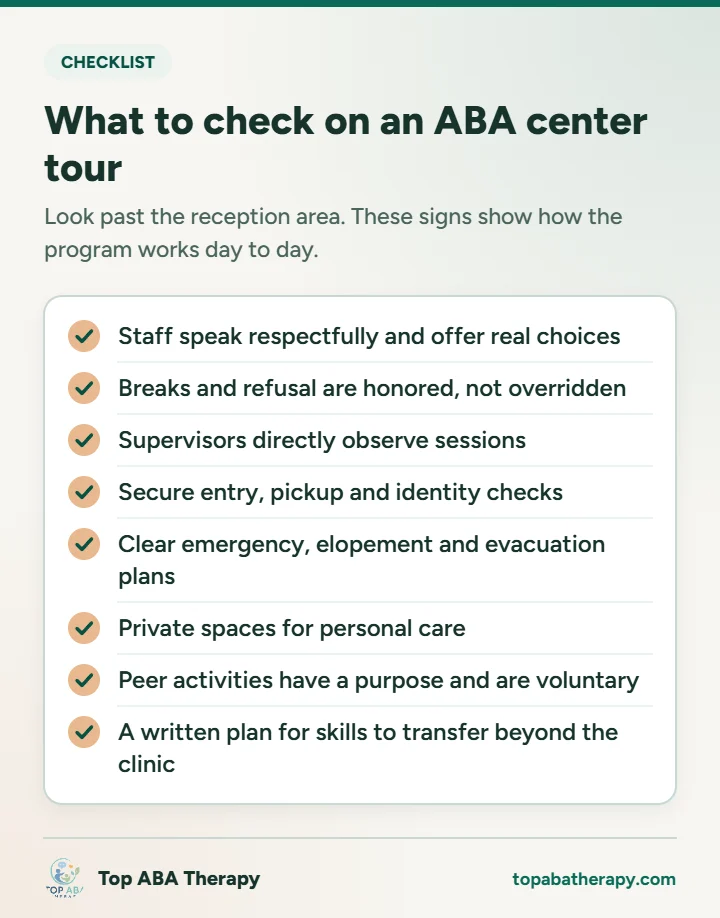
During a tour or observation, look beyond enthusiasm. Notice whether staff speak respectfully, offer choices, respond to communication, recognize signs of distress, preserve dignity during personal care, and explain what they are doing. Ask how the organization obtains consent and attends to assent or withdrawal where applicable.
Safety, health, and privacy questions
Request written policies relevant to the actual program:
- Entry, exit, visitor, pickup, and identity-verification controls.
- Elopement, medical emergency, fire, severe weather, and evacuation procedures.
- Staff background checks, training, incident reporting, and required notifications.
- Medication, allergy, food, toileting, personal-care, and infection-control boundaries.
- Transportation and community-outing authorization, vehicles, drivers, and restraints.
- Camera, observation room, photography, audio, telehealth, and record-retention practices.
- Use, approval, monitoring, and fading of any restrictive or crisis procedure.
Proximity is not supervision: a BCBA working elsewhere in the building does not prove direct observation, timely feedback, or plan review. Ask what the accountable clinician actually sees, records, decides, and communicates for this case.
Generalization cannot be assumed
A person may demonstrate a skill with one staff member, material, room, or prompt without using it elsewhere. The treatment plan should name the people, settings, materials, and conditions across which the skill needs to work. It should then measure generalization and maintenance rather than infer them from clinic performance.
How should families evaluate an ABA center?
Treatment and outcomes
- How are priorities chosen with the person and family?
- Why is a center recommended for these particular goals?
- Which outcomes are measured, and how often are plans reviewed?
- How are adverse effects, assent, quality of life, and family feedback tracked?
- What are the step-down, transition, discharge, and referral criteria?
Operations
- What are the hours, attendance expectations, holiday closures, and cancellation rules?
- How often are assigned staff changed?
- Are families allowed to observe, and under what privacy rules?
- Which ages and needs are served in the same spaces?
- What is the complaint process and who owns or operates the center?
Coverage and cost
- Is the organization in network at this exact location?
- Are assessment, direct treatment, caregiver training, group services, and telehealth billed differently?
- Does authorization specify setting, units, dates, and rendering professionals?
- What estimate, attendance policy, and financial agreement will be provided in writing?
Provider participation and authorization can change. Verify details directly with both the center and payer before relying on a directory label. Our guide to confirming ABA coverage with your plan lists the questions to ask.
Center, home, community, or hybrid?
The appropriate setting follows the person’s goals and circumstances. Home-based care may allow direct work in household routines; a center may make certain resources, transitions, or peer arrangements easier; community care may be needed for community goals. A hybrid model can combine settings if responsibilities and generalization plans are clear. Our in-home vs center-based comparison walks through the tradeoffs factor by factor.
Make the decision from evidence, not appearance
Ask for current credentials, state licensing where applicable, sample treatment and progress-report structures, supervision expectations, safety and privacy policies, coverage verification, and transition criteria. Tour the spaces used by the relevant program, not only a staged reception area. If possible, compare more than one organization.
Frequently asked questions about center-based ABA
Is center-based ABA the same as school-based ABA?
No. A clinic is a healthcare or treatment environment, while school services are governed by educational purposes, teams, and rules. Coordination may be useful with permission, but one setting does not automatically replace the other.
Does a center guarantee more BCBA supervision?
No. Physical proximity does not reveal how often the accountable clinician observes sessions or changes the plan. Request the actual supervision schedule, method, responsible name, and process for documenting clinical decisions.
Are peer activities always part of center-based ABA?
No. Some centers have group opportunities, while others do not, and being near peers is not an outcome by itself. Ask how participants are grouped, what goal the activity serves, and how choice, communication, and privacy are protected.
Can parents observe center-based sessions?
Observation policies differ because centers must balance family participation with every client’s privacy. Ask about live, recorded, remote, or scheduled observation and how the provider shares data and responds when a family requests more visibility.
What should my child bring to an ABA center?
Ask the center for its list, which often includes a change of clothes, any communication device, comfort items, and labeled snacks if outside food is allowed. Share allergy, medication, and personal-care information in writing before the first day, and confirm how belongings and devices are stored.
The bottom line
Center-based ABA therapy can offer arranged spaces, nearby supervisors, and planned peer opportunities, but the building is never the outcome. Judge a center by how it individualizes goals, honors refusal, supervises staff in the room, keeps people safe, and shows that skills carry over to home, school, and community. Tour during real sessions, get policies and costs in writing, and compare more than one option. When you are ready, find center-based ABA providers near you.